


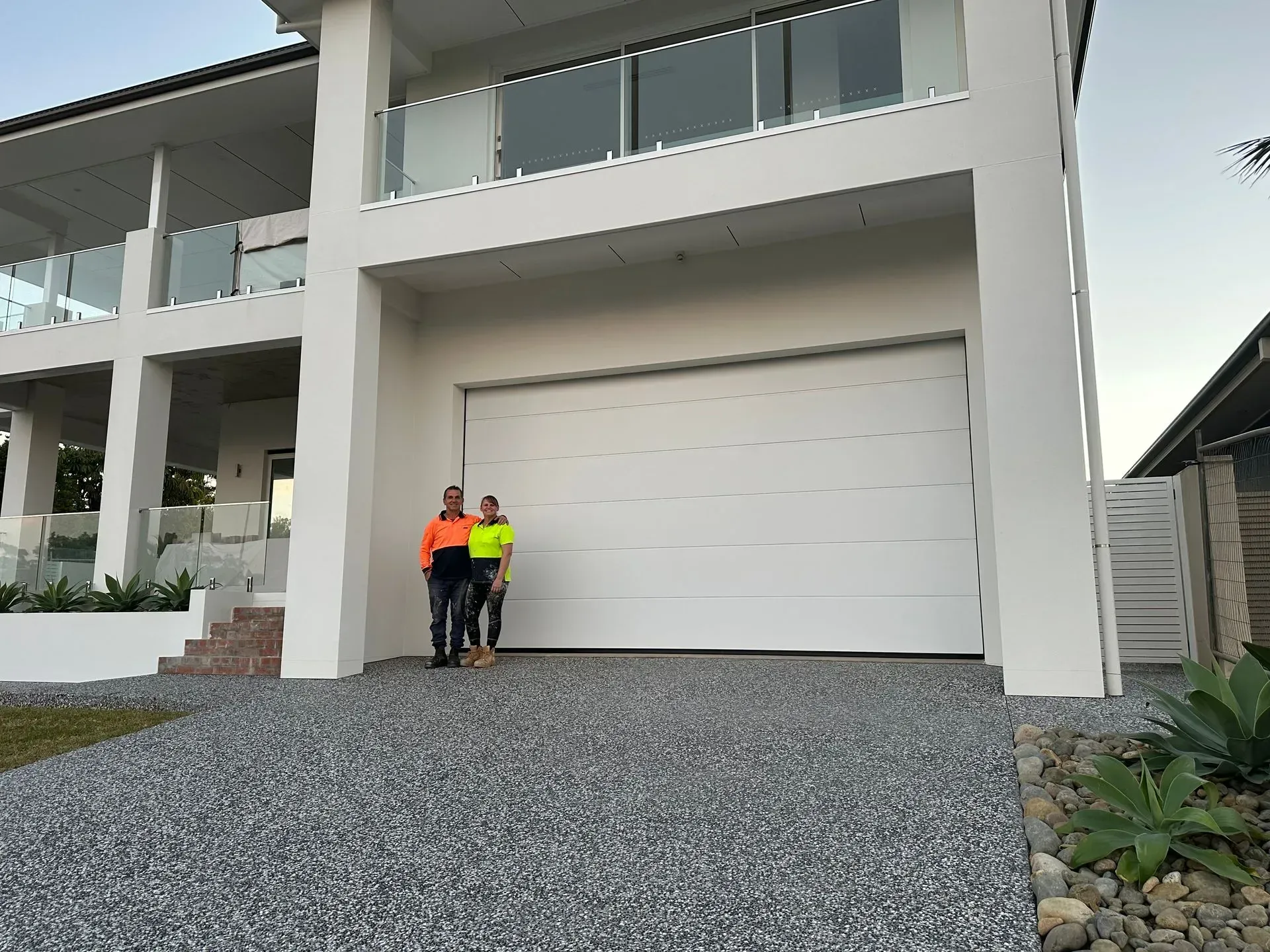
After 14 build-and-reno projects, you’d think Mick and Dee might be ready to take it easy. But their latest home on the Coffs Coast proves that their passion for property and their serious DIY skills are still going strong. They’ve tiled, painted, planned, and perfected every inch of this place. And their absolute favourite feature? The garage door. We joined them in the driveway to chat about DIY life, coastal living, and why a German-made door has captured their hearts. Let’s start with the build… Q: First off – this place is stunning. Tell us a bit about the build. What made this one different or special compared to your past projects? Mick: “This one’s our final build. We knew it was the end, so every decision mattered. We actually found the block by chance back in 2016 on the way to look at something else. Twenty-four hours later, it was ours.” Dee: “It’s our baby. We’ve done plenty of projects before, but this one really feels like home.” Q: You’ve now completed 14 homes – that’s huge. What keeps you coming back to the process of building or renovating? Mick: “It all started in 1994, after a dispute with a builder in WA. I said never again. Since then, we’ve been owner-builders. We like the control, we’re particular, and we want it done right.” Dee: “It’s about pride in workmanship. If something isn’t right, I’ll fix it. That satisfaction never gets old.” Q: You’ve done so much yourselves – we heard Dee even tackled all the tiling? That’s next level. How do you usually split the workload? Dee: “I take on most of the finishing work, like tiling and painting.” Mick: “I’m the organiser. Schedules, paperwork, Bunnings and Mitre 10 runs, setting things up so she can focus. Depending on the stage, sometimes I’m her helper, sometimes she’s mine. ” Q: With that much experience under your belts, how do you decide what you’ll DIY and when to bring in the pros? Mick: “We stick with trades we know and trust, even if we bring them from interstate. For certain jobs, we’d rather pay by the hour so they can take their time and get it right.” Dee: “And honesty is everything. If something gets damaged, just tell us. We’ll sort it out before it becomes a bigger problem. Coastal life vibes… Q: You’ve settled here on the Coffs Coast. What drew you to this part of the world? Dee: “We were looking for views and a livable climate. We wanted either ocean or valley views, and somewhere warmer than Victoria. Here it’s relaxed and liveable.” Mick: “And the lifestyle. People say you’re on ‘Coffs time’ now. It’s slower, easier, and we love it.” Q: How does living by the coast shape how you design your homes? Do you find yourself choosing different materials or colours? Dee: “Longevity first. We choose materials that can handle sea air, and I love a neutral, coastal palette.” Mick: “I’ve always leaned neutral anyway. It makes a home appeal to anyone. But we also design to suit the environment.” Q: What’s your favourite part about the lifestyle here? Mick: “The weather is incredible. Warm, not too humid, and no freezing winters.” Dee: “It’s the people. It’s friendlier, slower paced, and we’ve built great friendships here.” Garage door glow-up… Q: Let’s talk doors! You were originally going to go with a standard sectional, but changed your mind. What led to that decision? Mick: “We’ve always used B&D. But with a door this big, we worried about rippling. Andrew showed us the Hormann insulated door and it just felt stronger, smoother, and more premium.” Q: Andrew from Garage Doors and More had a look at the space and recommended a Hormann door instead. What made you trust his advice? Dee: “He explained the difference. Better insulation, brighter finish, no rippling. We like dealing with people who know their stuff.” Mick: “And you could see the quality straight away. Even the springs looked commercial-grade.” Q: This door is no small feature – it’s over 3 metres high and 5.2 metres wide. That’s a serious garage! What inspired you to go that big? Mick: “Street presence. The garage is a third of your frontage. If it looks average, the whole house looks average. We wanted it to stand out for the right reasons.” Q: And being fully insulated, have you noticed any difference in how the garage feels day-to-day? Dee: “Absolutely. Even in summer sun, it stays comfortable. No sweltering heat, no icy chill.” Q: The Traffic White finish is stunning. It looks so clean and crisp against the rest of your home – what made you land on that colour? Dee: “I wanted the brightest, cleanest white possible.” Mick: “And with our quarter-strength exterior, the crisp Traffic White gives a beautiful contrast.” Q: Have people commented on the door? What do your friends or neighbours say when they see it? Dee: “Everyone comments on how striking it is.” Mick: “It ties the whole build together. Definitely a talking point.” Q: And lastly – we heard the garage door is your favourite part of the house. What is it about it that makes it stand out so much for you? Mick: “No ripples, no compromises. Just smooth, strong, and smart.” Dee: “It’s practical, but beautiful too. Every time we pull into the driveway, it makes us smile. Winding down… or maybe not? Q: After 14 projects, this one seems special – what advice would you give to someone just starting out on their dream build? Mick: “Don’t rush. Pay by the hour if you want quality.” Dee: “And be honest. Pride in workmanship always shows.” Q: Would you choose a Hormann door again for your next project? Mick & Dee (together): “Absolutely.” Q: And the big question – is there a project #15 on the horizon… or are you finally hanging up the work boots? Mick: “We’re calling it quits. After the last little reno down the road.” Dee: “But never say never. We’ve said that before.”
Your garage door plays an essential role in your household as it provides extra security for your home and adds to the visual appeal of your property. However, most homeowners tend to ignore their garage doors and forget to invest time and effort in regular maintenance and servicing. If your garage doors operations come to a halt or are compromised in any way, it can trap your car in your garage and throw you off your schedule for the day. A malfunctioning garage door is a huge inconvenience for your household and poses a hazard to the security and safety of your family/property. It is important to understand the numerous benefits that regular garage door maintenance and servicing can have for your property. If you are having any issues with your garage door or if it is showing signs of breakdown then read on to find out why you need professional maintenance for your garage doors: Essential for your safety: In most households, the automatic garage door or roller door is probably one of the most used doors in the house. When your garage door fails to operate correctly it is hugely inconvenient and may compromise the security of your property and possessions. Avoid any threat of break-ins or intruders with regular garage door Tamworth maintenance schedule. Regardless of size and material, faulty garage doors are also responsible for injuries and damage to parked vehicles and surrounding property. All garage doors are extremely heavy and must be professionally serviced from time to time to eliminate any chances of such accidents. Conducting regular servicing and preventative maintenance on your garage door is essential to ensuring that safety is maintained, your property is secure at all times and the chance of breakdown is minimised. Save $$$: You would be surprised to find out that a broken or malfunctioning garage door can cost you tons of money and time. An annual garage door maintenance service is highly valuable and helps you save money that goes into costly repairs and machinery overhaul when the door stops functioning completely. Do not wait for the worst to happen, contact a garage door specialist to get yours serviced soon. As part of our routine maintenance service, a reliable garage door serviceman would check the condition of the bearings, cables, springs, motor parts, tracks and fittings, and other hardware components. The garage door specialist will make sure that all mechanisms are working perfectly and advise you if any repairs or replacements are required. Ease and convenience: A loud, noisy, and screechy garage door is an inconvenience to you and your neighbours. Aside from that, if your garage door is broken or damaged, it can greatly impact your convenience and peace of mind. As one of the most important entry points to your home, it is important to have a properly functioning and maintained garage door that does what it's supposed to without any hassle to you. Having a properly working garage door takes a lot of hassle off your shoulders, so do not avoid investing money on regular tune-ups and servicing. Garage Doors and More have built an excellent reputation amongst those seeking garage door repairs and garage door maintenance service in Tamworth, and the Coffs Harbour area. Our quality service, affordable pricing and unparalleled response time make us the best choice for all garage door repairs. We have years of experience and our team is committed to excellence, which means that we can quickly help you professionally repair a garage door. Considering new garage door installation ? We have you covered. For new garage doors Tamworth , or Coffs Harbour , with our wide range of modern and robust options, we’re certain to have the perfect garage door for your property. Get in touch with us today!
